
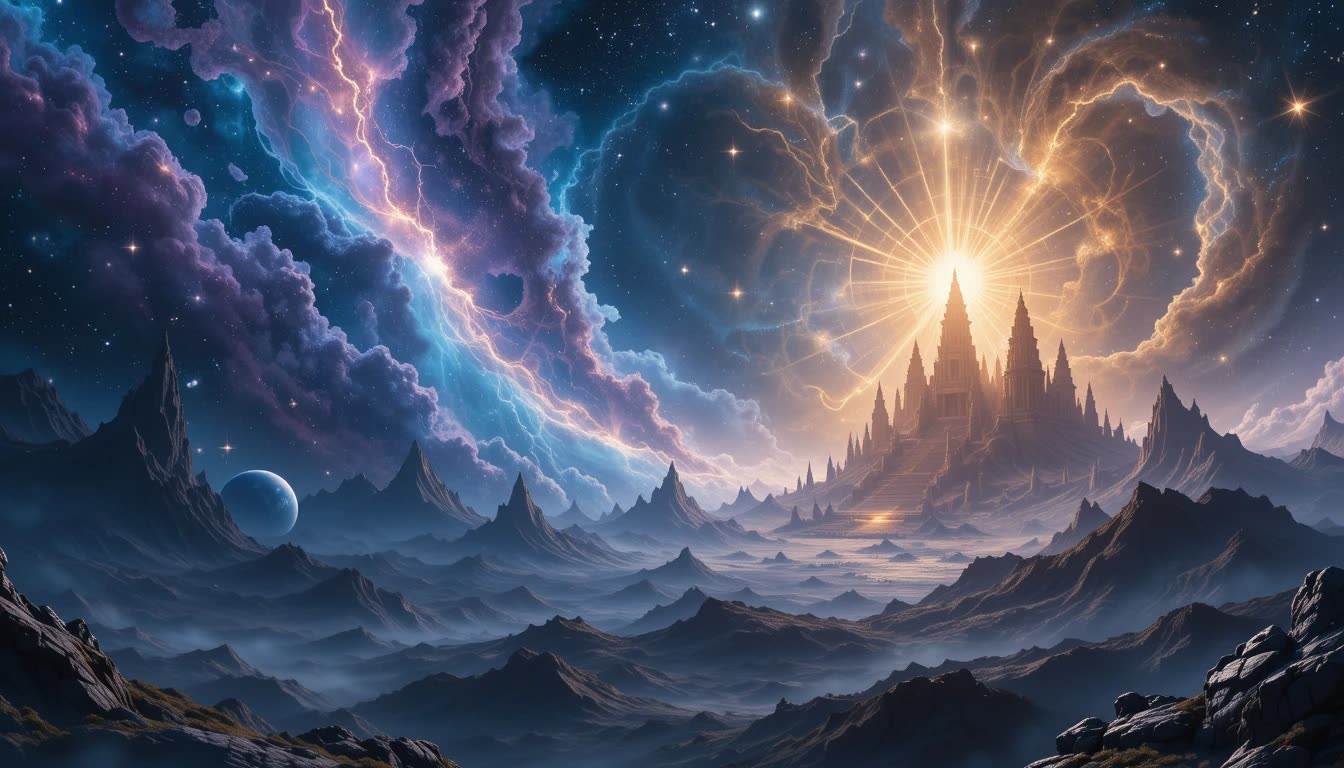
They were not born in the first breath. They came later, when the fire of the beginning had already cast its flames across the galaxies and the Aether rested, dreaming of forms more delicate, more akin to what would one day be called life.
The Celestial Gods emerged from the intertwining of ancient forces. They were not as vast as the first ones, but within them burned a more intimate flame, closer to the rhythm of worlds. Their eyes saw the stars as sisters, and the planets as gardens to be shaped. They came to fill the spaces left by the great hands of creation, to touch what was small, subtle, sensitive.
They were not made of eternity, but of time. Not silence, but voice. Where the Primordials were pure essence, the Celestials were expression: emotion, desire, connection. Each was called to dwell in a domain, to watch over a fragment of the great whole, as sentinels of order and mystery. And in that mission, their souls began to entwine with one another, forming alliances, rivalries, passions, and sacrifices. They were the ones who gave color to what had only been light. Who gave rhythm to what had merely pulsed. They taught the worlds to spin in harmony, and offered the heavens their first tales, their first melodies.
They are children of the Primordials, yes, but also of something new: of freedom, of experience, of pain and of love. They are the Celestial Gods. Those who walk among constellations… and write, with their very steps, the song of the cosmos.
A solar system for each god
The Celestial Gods act at the level of solar systems: a star and the planets that compose it. It is a very strong class of god, but one that stands below the Primordial Gods. They may have been created by the Primordials, or they may have arisen without depending on them, in the very evolution of the universe within the galaxies. The list of Celestials has no fixed number: it can grow.
The great stars
The five great Celestials (the Sun, Jupiter, Saturn, Uranus and Neptune) were, in Rafandria, the equivalent of great stars. But the Cosmic War of Exodus consumed a great deal of power. To preserve the support of the surviving planets from what remained of Rafandria, only the Sun remained a star. Jupiter, Saturn, Uranus and Neptune spent much of their power to save what remained, and that is why they are today great gas giants. That is why, in the history of Rafandria, only the Sun exists as a star. Eridân was destroyed in the war. Rafandai took all the Celestial Gods out of Eridân because they had reached a point where they could no longer endure. Eridân was another galaxy: the Milky Way is a younger galaxy, unknown until then, a place no one knew, and arriving in it was unexpected. It was in the reality of the Milky Way that the gods found their inspiration, and that is why they are in it today.
Immense power, certain end
The planets, like our star, the Sun, have immense power and a life of billions of years. But that life will have an end, and they will have an end. It is the same concept that applies to the characters of greater strength, power and longevity compared to the smaller ones, such as humans and dwarves: the greater the being, the longer its life, but everything has its end, until that end arrives with the Heat Death.
The Birth of the Celestial Axis
The first five Celestials were born of the Triogenesis, a process of creation apart, unbound from biological reproduction: they are no one’s children, nor heirs. Rafandai brought five seeds of light, the intention; Galathor served as the structure, the core that held them; and Mysteria sculpted their forms. The contact between them had a single purpose: to generate the energy needed to give existence to the five. So were born Solvathor (the Sun), Jovaris (Jupiter), Saturion (Saturn), Urandor (Uranus) and Nepturis (Neptune). The Heralds of the Night call this moment the “Fragments of Shadow”, and the eldest say that, as long as these five exist, the universe will never fully collapse.
The others came later, as direct children of these first five: Mercurion (Mercury), Venaria (Venus), Terralia (Earth), Marvalis (Mars) and Plutonis (Pluto). Venaria, Terralia and Marvalis were born of the Retrogenesis, the branch of the Triogenesis for those who are not gods.
Who belongs here
Music videos of Celestial Gods





The order of the Celestial Gods
Each Celestial God is a body of the solar system. Five of them are the great Celestials; the other worlds are their children, and, born of Celestials, they are Celestial Gods as well.
The five great Celestials
The principal Celestial Gods.
Their children
Children of the great Celestials, and Celestial Gods themselves.
The music of Celestial Gods
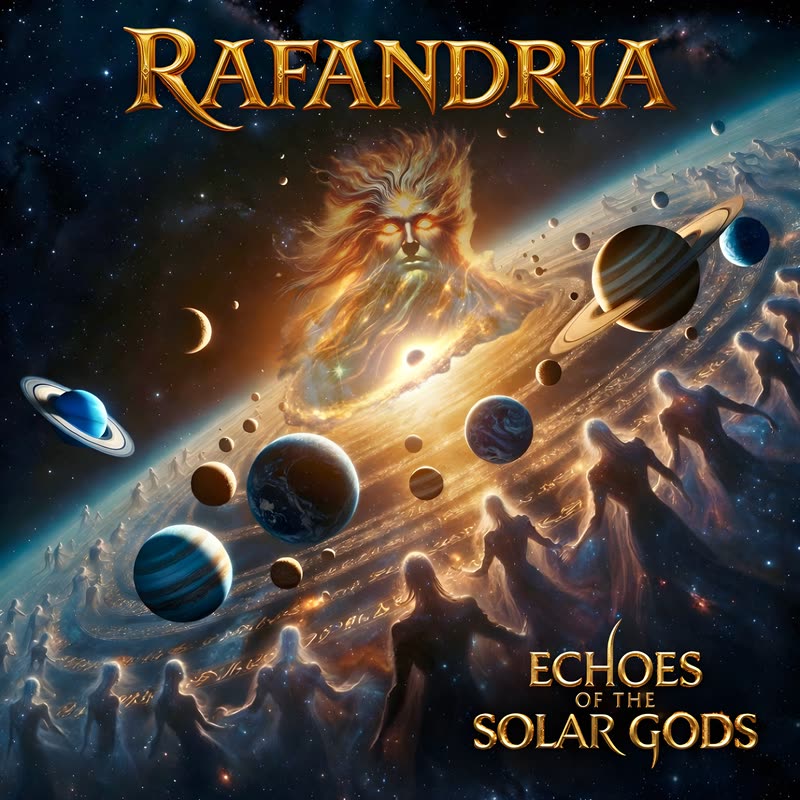
News about Celestial Gods
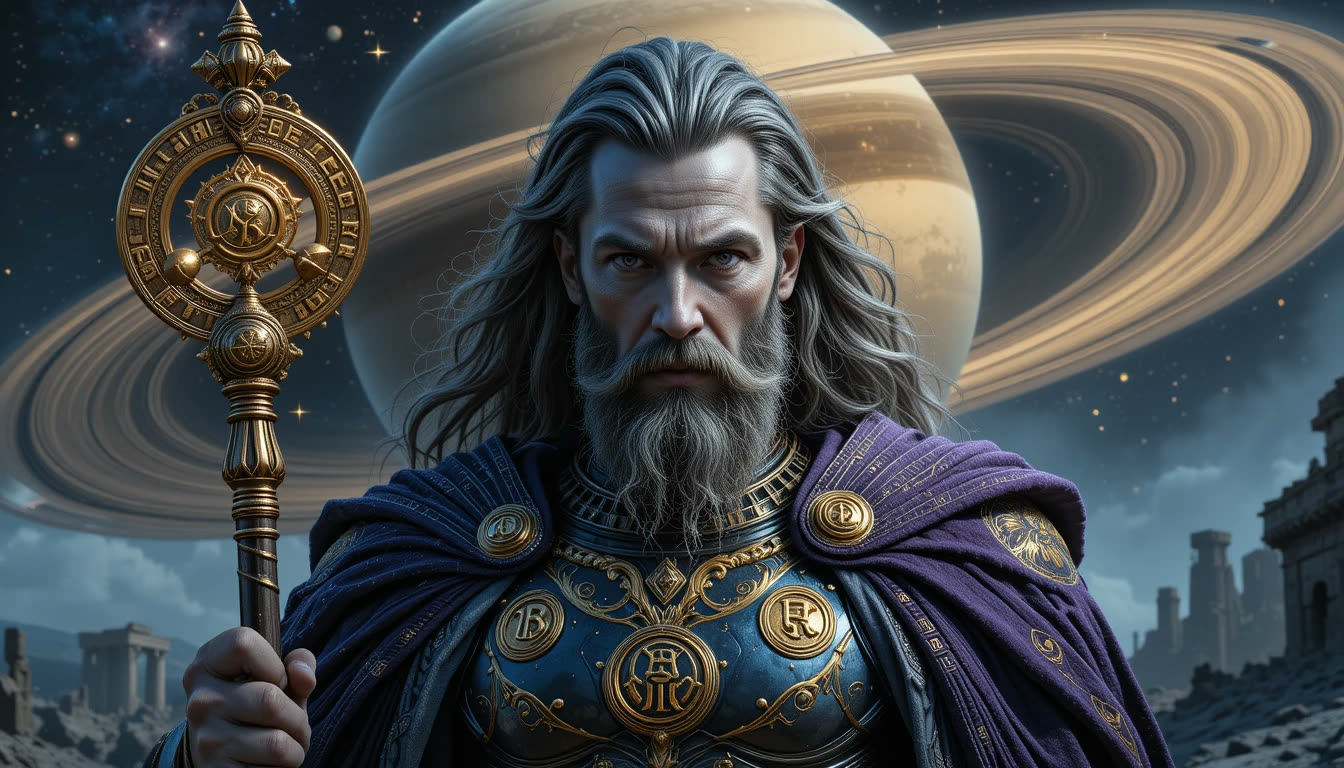
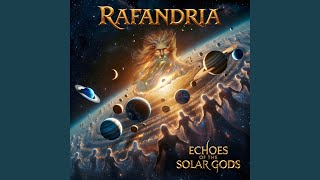
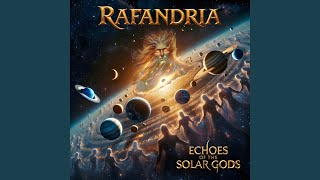
Echoes of The Solar Gods has been released!
Today marks a historic milestone for the channel — a day that will resonate across the universe! The chapter Echoes of The Solar Gods has just been released worldwide on all digital platforms. This moment portrays the critical turning point of Fracture II.
Echoes Of The Solar Gods – The Release That Will Shake the Musical Universe!
🌌 Echoes Of The Solar Gods – The Release That Will Shake the Musical Universe! 🎶🔥